Queer Places:
Il Vittoriale degli Italiani, Via al Vittoriale, 12, 25083 Gardone Riviera BS
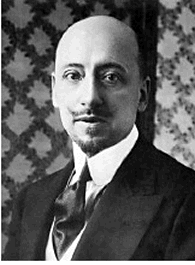 Gabriele D’Annunzio (March 12, 1863 – March 1, 1938), born on March 12, 1863, in Pescara, Italy, stands as one of the most flamboyant, controversial, and
influential figures in modern Italian history. A master of aestheticism, a prolific poet, playwright, and novelist, and a decorated military hero,
D'Annunzio lived his entire life as a work of art—a philosophy he termed estetismo. Raised in a prosperous middle-class family, he showed immense literary
talent early on, publishing his first collection of poetry, Primo vere, at the age of sixteen while studying at the prestigious Cicognini College in Prato.
He moved to Rome in the early 1880s, where he rapidly immersed himself in high society, journalism, and bohemian literary circles, cultivating a public
persona defined by luxury, debt, seduction, and artistic radicalism. His early novels, notably Il piacere (The Child of Pleasure, 1889), cemented his
reputation as a master prose stylist whose decadent heroes pursued beauty and sensual gratification above all else.
Gabriele D’Annunzio (March 12, 1863 – March 1, 1938), born on March 12, 1863, in Pescara, Italy, stands as one of the most flamboyant, controversial, and
influential figures in modern Italian history. A master of aestheticism, a prolific poet, playwright, and novelist, and a decorated military hero,
D'Annunzio lived his entire life as a work of art—a philosophy he termed estetismo. Raised in a prosperous middle-class family, he showed immense literary
talent early on, publishing his first collection of poetry, Primo vere, at the age of sixteen while studying at the prestigious Cicognini College in Prato.
He moved to Rome in the early 1880s, where he rapidly immersed himself in high society, journalism, and bohemian literary circles, cultivating a public
persona defined by luxury, debt, seduction, and artistic radicalism. His early novels, notably Il piacere (The Child of Pleasure, 1889), cemented his
reputation as a master prose stylist whose decadent heroes pursued beauty and sensual gratification above all else.
D’Annunzio’s personal life was characterized by a labyrinth of high-profile affairs, passionate liaisons, and scandalous romantic pursuits that often
fueled his literary output. His first major marriage was to Duchess Maria Hardouin di Gallese in 1883, with whom he had three sons before the marriage
dissolved amid financial ruin and his relentless infidelities. Among his most famous muses was the legendary Italian actress
Eleonora Duse, whom he met in 1894. Their tempestuous, decade-long romance combined intense artistic
collaboration with profound emotional turmoil; D'Annunzio wrote several of his greatest theatrical works—such as La città morta and Francesca da
Rimini—specifically to showcase Duse on international stages, though his public philandering ultimately drove her away. Beyond Duse, his life featured
countless mistresses, noblewomen, and admirers, all while he maintained a notorious reputation as a relentless dandy who spent profligately on art, horses,
and lavish estates.
While D'Annunzio's public relationships with women are well-documented, his life and artistic output also intersected significantly with same-sex
desire, homosocial aestheticism, and the fluid sexual norms characteristic of the late-nineteenth-century Decadent movement. As a core proponent of
aestheticism in Italy, D'Annunzio drew heavily from the transnational currents of European decadence, which frequently explored themes of gender
transgression, homoeroticism, and androgyny. In his literary works, male beauty, intense homosocial devotion, and Greek-inspired homoerotic ideals are
recurring motifs, reflecting the broader cultural fascination with Hellenic love among European intellectuals of his era. Furthermore, D'Annunzio’s
intimate social circle in Rome, Paris, and later at his estate, the Vittoriale degli Italiani, included numerous artists, writers, and aristocrats who
lived outside conventional heteronormative boundaries. His writings frequently blurred strict lines of gender and desire, aligning with the fin-de-siècle
re-evaluation of love that laid early, complex groundwork for modern understandings of sexual identity, even as D'Annunzio himself operated within the
aristocratic and artistic codes of his time rather than modern political LGBTQ+ frameworks.
With the outbreak of the First World War, D'Annunzio transformed himself from an aging literary icon into an aggressive nationalist propagandist and
military adventurer. Despite being in his fifties, he volunteered for active duty, serving with immense daring in the cavalry, the infantry, and the air
force, where he famously led the Flight over Vienna in 1918, dropping propaganda leaflets over the Austrian capital. His exploits earned him numerous
medals and cemented his status as a national hero. Following the war, discontented with the perceived "mutilated victory" of Italy at the Paris Peace
Conference, D'Annunzio led a force of nationalist irregulars to seize the disputed city of Fiume (now Rijeka, Croatia) in September 1919. He established a
utopian, highly theatrical micro-state known as the Italian Regency of Carnaro, which lasted for over a year and served as a precursor to fascist political
ritual, utilizing mass rallies, black-shirted militias, Roman salutes, and impassioned balcony speeches.
Although Benito Mussolini’s emerging Fascist regime borrowed heavily from D'Annunzio's political theater, populist rhetoric, and aestheticized
authoritarianism, Mussolini viewed the poet as a potential political rival and effectively sidelined him, showering him with honors and financial stipends
while keeping him virtually confined to his sprawling estate, the Vittoriale, on the shores of Lake Garda. During his final two decades, D'Annunzio
transformed the Vittoriale into a grandiose, museum-like monument to his own life and exploits. He spent his remaining years writing memoirs, collecting
artifacts, and receiving political and literary visitors, though his direct political influence waned. Gabriele D'Annunzio died of a cerebral hemorrhage on
March 1, 1938, at the Vittoriale, leaving behind a complex legacy as a brilliant stylist and national mythmaker whose life bridged the golden age of
European aestheticism and the darkest currents of twentieth-century authoritarianism.
References:
Other references:
- "The Pike: Gabriele D'Annunzio – Poet, Seducer & Preacher of War" by Lucy Hughes-Hallett (Farrar, Straus and Giroux, 2013) – Widely considered the definitive, comprehensive English-language biography of D'Annunzio, exploring his literary career, personal affairs, and political radicalism.
- "Gabriele D'Annunzio: Defiant Archangel" by J.R. Woodhouse (Oxford University Press / Clarendon Press, 1998) – An authoritative academic biography examining his dual roles within Italian culture, the theater, and European political history.
- "Gabriele D'Annunzio: The Dark Flame" by Paolo Valesio (Yale University Press, 1992) – A critical, text-based examination of D'Annunzio's prose, poetry, and aesthetic philosophy.
- "Encyclopædia Britannica" – Standard reference entries detailing his chronology as a leading Italian novelist, playwright, military hero, and political figure.
- Academic Research Resources and Literary Archives (such as EBSCO Research Starters) – Comprehensive essays focusing on his ties to the European Decadent movement, French symbolism, and his complex influence on 20th-century Italian modernism and fascism.
Support this project
This website is a passion project researched, developed, and funded entirely by me. If you find the content valuable and would like to help support the ongoing research and hosting costs, any contribution is deeply appreciated.
Thank you for keeping this independent resource alive!
My books on Amazon: Elisa Rolle's books
BACK TO HOME PAGE
